
India's economic growth accelerated to 8.4 per cent in the third quarter of 2023-24, mainly due to good performance by the manufacturing, mining & quarrying and construction sectors. The Indian economy recorded a growth of 8.4 per cent in the third quarter of this fiscal (October-December 2023), according to data released by the National Statistical Office (NSO) on Thursday.

India's services sector activity fell to a 10-month low in September as new businesses, international sales and output growth moderated, a monthly survey said on Friday. The seasonally adjusted HSBC India Services Business Activity Index fell from 60.9 in August to 57.7 in September, indicating that though the output registered an increase, the pace of growth was the slowest since November 2023. In the Purchasing Managers' Index (PMI) parlance, a print above 50 means expansion, while a score below 50 denotes contraction.

From the Sensex pack, Reliance Industries, Bajaj Finserv, HDFC Bank, Adani Ports, Maruti Suzuki India, Axis Bank, Hindustan Unilever, Sun Pharmaceuticals and Asian Paints were among the laggards. Reliance Industries fell the most by 2.38 per cent to close at Rs 1,171.10 apiece.
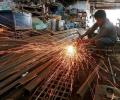
Manufacturing activities in India remained robust and price pressures were contained in October as new orders and production rose at a slower but stronger pace, according to a monthly survey released on Tuesday. The seasonally-adjusted S&P Global India Manufacturing Purchasing Managers' Index (PMI) was up from 55.1 in September to 55.3 in October. The October PMI data pointed to an improvement in overall operating conditions for the 16th straight month.

The meltdown in Dalal Street that wiped out investor wealth to the tune of 44 trillion in 2025 also seems to be having a ripple effect on the country's vibrant automobile retail sales.

India will be the world's third-largest economy by 2028 as it becomes the world's most sought-after consumer market and gains share in global output, driven by macro stability influenced policy and better infrastructure, Morgan Stanley said. From a $3.5 trillion economy in 2023, the Indian economy is projected to expand to $4.7 trillion in 2026, which will make it the fourth largest in the world behind the US, China and Germany.

'Could the impending new crisis, vibe coding, similarly create not a disaster like what befell Indian handlooms during the Industrial Revolution but another opportunity like what the Y2K crisis created?' asks Ajit Balakrishnan.

Against the Reserve Bank of India's (RBI's) projection of 7.1 per cent, India's first quarter (Q1) 2024-25 (FY25) gross domestic product (GDP) growth came in at 6.7 per cent. This is in line with market expectations and significantly lower than the 7.8 per cent recorded in the fourth quarter (Q4) 2023-24 (FY24) and 8.2 per cent in Q1FY24. The quarter witnessed decreased government consumption and investment spending due to the parliamentary election.

Macroeconomic data announcements, trading activity of foreign investors and global trends will guide equity market movement this week, which would also mark the beginning of the new calendar year and month, analysts said.

India's industrial production growth remained subdued for the second straight month and expanded by 3.2 per cent in October, mainly due to the waning low base effect while mining, power and manufacturing sectors performed well. The manufacturing sector, which constitutes 77.63 per cent of the Index of Industrial Production (IIP), grew two per cent in October, according to data released by the National Statistical Office (NSO) on Friday. The mining sector output rose 11.4 per cent in October, while power generation increased 3.1 per cent.

India's manufacturing PMI rose to 54.5 in December, 2014, while in the corresponding period a year ago it stood at 50.7, just above the crucial 50 mark which separates growth from contraction.

Institutional investments in Indian real estate have seen a strong start to 2025, with inflows reaching $ 1.3 billion in the first quarter - a 31 per cent year-on-year (YoY) increase. This growth was primarily driven by domestic investments, which accounted for 60 per cent of the total inflows during the quarter. With $ 0.8 billion inflows, domestic investments saw a 75 per cent annual rise and were largely focused on industrial & warehousing and office segments.

There are challenges galore before him, and it is not going to be easy. In the next four years, he has to conjure a system that changes the optics about him and the BJP both nationally and internationally so that he can ride back on his own, claim the top slot, and not have to lean on a coalition, asserts Ramesh Menon as Modi 3.0 completes a year in power.

India's manufacturing sector activities gained further strength in November, and witnessed the strongest increase in production and sales since February on improving market conditions, a monthly survey said on Wednesday. The seasonally adjusted IHS Markit India Manufacturing Purchasing Managers' Index (PMI), increased from 55.9 in October to 57.6 in November, signalling the strongest improvement in the health of the sector in ten months. Moreover, the headline figure was well above its long-run average of 53.6.

Industrial production expanded a provisional 3.4 per cent year-on-year in June.

India's manufacturing sector growth steadied in May, with new orders and production increasing at similar rates to those registered in the previous month, while demand showed signs of resilience and improved further in spite of another uptick in selling prices, a monthly survey said on Wednesday. The seasonally adjusted S&P Global India Manufacturing Purchasing Managers' Index (PMI) stood at 54.6 in May, little changed from 54.7 in April, pointing to a sustained recovery across the sector. The May PMI data pointed to an improvement in overall operating conditions for the eleventh straight month.
Factory production expanded by 1.7 per cent on an annual basis in February on account of improved performance by the mining and power generation sectors, as per government data released on Tuesday. The Index of Industrial Production (IIP) had contracted by 3.2 per cent in February 2021. The growth was 1.5 per cent in January 2022. As per the data released by the Ministry of Statistics and Programme Implementation, the growth in the mining sector was 4.5 per cent against a contraction of 4.4 per cent in February 2021.
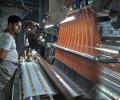
India's manufacturing sector activities gained further strength in October as companies scaled up production and stepped up input purchasing in anticipation of further improvements in demand, a monthly survey said on Monday. Robust gains in new work aided production growth in October as output and new orders expanded at fastest rates in seven months, while business optimism hit a six-month high, the survey said. The seasonally adjusted IHS Markit India Manufacturing Purchasing Managers' Index (PMI) rose from 53.7 in September to 55.9 in October, pointing to the strongest improvement in overall operating conditions since February.

Industrial production surged by 13.6 per cent in June mainly due to a low-base effect and good performance by manufacturing, mining and power sectors but the output remained below the pre-pandemic level. The manufacturing sector, which constitutes 77.63 per cent of the Index of Industrial Production (IIP), grew by 13 per cent in June this year, according to the data released by the National Statistical Office (NSO) on Thursday. The mining sector output rose by 23.1 per cent in June while power generation increased by 8.3 per cent.

India's manufacturing sector activity strengthened in December, with manufacturers stepping up production and input buying amid efforts to rebuild their inventories following business closures earlier in the year, a monthly survey said on Monday. The seasonally adjusted IHS Markit India Manufacturing Purchasing Managers' Index (PMI) was at 56.4 in December, a tick higher than November's reading of 56.3 and above the critical 50 threshold for the fifth straight month. In PMI parlance, a print above 50 means expansion, while a score below that denotes contraction.

India's economic growth rate is estimated to slip to a four-year low of 6.4 per cent in 2024-25, mainly on account of poor showing by the manufacturing and services sector, according to government data released on Tuesday. The gross domestic product (GDP) rate of 6.4 per cent will be the lowest since the Covid year (2020-21) when the country witnessed a negative growth of 5.8 per cent.
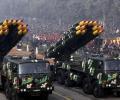
After lagging behind the broader market over the past three and six months, defence sector stocks have regained ground, reversing their performance from the past month. Concerns about slowing order inflows, execution hurdles, supply chain disruptions, and high valuations had weighed on the sector.

India's services sector activity eased in August but growth rates for new orders remain elevated, as services firms indicated the sharpest upturn in new export business which acted as a catalyst for firms to expand their workforces as well as output, a monthly survey said on Tuesday. Despite falling from 62.3 in July to 60.1 in August, the seasonally adjusted S&P Global India Services PMI Business Activity Index indicated one of the strongest increases in output seen since mid-2010. For the 25th straight month, the headline figure was above the neutral 50 threshold.

India's services sector growth recorded another month of robust expansion in July, albeit at a slightly slower pace than in June, largely supported by robust demand conditions and investment in technology, a monthly survey said on Monday. The seasonally adjusted HSBC India Services Business Activity Index was at 60.3 in July, down only fractionally from 60.5 in June. In the Purchasing Managers' Index (PMI) parlance, a print above 50 means expansion, while a score below 50 denotes contraction.
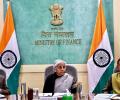
The Budget assumes significance as it comes on the back of lower-than-expected growth numbers during the second quarter and geopolitical uncertainty.

The Indian services sector expanded at the strongest rate in 12 years in February supported by favourable demand conditions and new business gains, a monthly survey said on Friday. The seasonally adjusted S&P Global India Services PMI Business Activity Index rose from 57.2 in January to 59.4 in February -- its highest level in 12 years. For the 19th straight month, the headline figure was above the neutral 50 threshold. In Purchasing Managers' Index (PMI) parlance, a print above 50 means expansion while a score below 50 denotes contraction.
India's services sector growth eased slightly in April but growth of new business and output remained sharp and among the fastest in 14 years amid favourable economic conditions and strong demand, a monthly survey said on Monday. The seasonally adjusted HSBC India Services Business Activity Index fell from 61.2 in March to 60.8 in April, highlighting one of the strongest growth rates seen in just under 14 years. Survey members attributed the latest upturn in output to favourable economic conditions, demand strength and rising intakes of new work.

India's economic growth slowed to near two-year low of 5.4 per cent in the July-September quarter of this fiscal due to poor performance of manufacturing and mining sectors, but the country continued to remain the fastest-growing large economy, data showed on Friday. The gross domestic product (GDP) had expanded by 8.1 per cent in the July-September quarter of 2023-24 fiscal. The previous low level of GDP growth at 4.3 per cent was recorded in the third quarter (October-December 2022) of financial year 2022-23.

Manufacturers indicated that the ongoing relaxation of COVID-19 restrictions, better market conditions and improved demand helped them to secure new work in October.
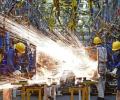
Industrial production declined by 10.4 per cent in July, mainly due to lower output of manufacturing, mining and power generation, as per the government data released on Friday.

India's manufacturing sector activity witnessed a significant loss of growth momentum in May due to the intensification of the COVID-19 crisis and its detrimental impact on demand, a monthly survey said on Tuesday. The seasonally adjusted IHS Markit India Manufacturing Purchasing Managers' Index (PMI), fell to 50.8 in May, down from 55.5 in April, as companies observed the slowest rises in new work and output in ten months amid intensification of the COVID-19 crisis. In PMI parlance, a print above 50 means expansion while a score below 50 denotes contraction.

The growth was primarily driven by domestic investments, which accounted for 60 per cent of the total inflows during the first quarter of the financial year.

Budget 2025 lays down a transformational roadmap for India's digital and economic future, focusing on AI-driven enterprise modernisation, workforce skilling, and sustainable innovation. With bold investments in AI, digital infrastructure, and ease of doing business, the government has set the stage for businesses to scale, innovate and compete on a global level.

India's services sector growth accelerated in April, as strong demand conditions resulted in the fastest increase in new business and output in close to 13 years, a monthly survey said on Wednesday. The pick-up in demand occurred in spite of escalating price pressures. The seasonally adjusted S&P Global India Services PMI Business Activity Index rose from 57.8 in March to 62.0 in April, signalling the fastest expansion in output since mid 2010, amid a pick-up in new business growth and favourable market conditions.
India's services sector growth quickened in June from May's five-month low, amid a stronger rise in new orders and an unprecedented expansion in international sales, a monthly survey said on Wednesday. The seasonally adjusted HSBC India Services Business Activity Index rose from 60.2 in May to 60.5 in June, pointing to a sharp expansion in output. In the Purchasing Managers' Index (PMI) parlance, a print above 50 means expansion, while a score below 50 denotes contraction.
Factory production expanded by 1.3 per cent on an annual basis in January on account of better performance by mining and manufacturing sectors, though capital goods segment remained in contraction mode, as per government data released on Friday. The Index of Industrial Production (IIP) had contracted by 0.6 per cent in January 2021. The growth was 0.7 per cent in December 2021. As per the data released by the Ministry of Statistics and Programme Implementation, the growth in the mining sector was 2.8 per cent against a contraction of 2.4 per cent in January 2021.

Deputy Governor Michael Patra warned about the spillover effects of food inflation.
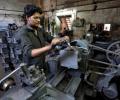
India's manufacturing sector activities witnessed the strongest rate of growth in three months in July amid improved demand conditions and easing of some local COVID-19 restrictions, a monthly survey said on Monday. The seasonally adjusted IHS Markit India Manufacturing Purchasing Managers' Index (PMI) rose from 48.1 in June to 55.3 in July, pointing to the strongest rate of growth in three months. In PMI parlance, a print above 50 means expansion while a score below 50 denotes contraction.

Following the lacklustre growth numbers in the second quarter (Q2FY25), economists believe the upcoming Union Budget for 2025-26 should focus on reforms that will stimulate consumption, manufacturing and spur employment. India's growth unexpectedly slowed to 5.4 per cent in the second quarter, due to low capital formation, weak consumption, besides adverse weather impact.

Lithium-ion cells, primarily imported from China, are likely to become cheaper following punitive tariffs imposed by the US on Chinese battery cells.
